A guide for manufacturing leaders: how to navigate the Digital Manufacturing Ocean
A guide for manufacturing leaders: how to navigate the Digital Manufacturing Ocean
A guide for manufacturing leaders: how to navigate the Digital Manufacturing Ocean
Share:
A guide for manufacturing leaders: how to navigate the Digital Manufacturing Ocean
Share:
A guide for manufacturing leaders: how to navigate the Digital Manufacturing Ocean
Share:
A guide for manufacturing leaders: how to navigate the Digital Manufacturing Ocean
Share:
A guide for manufacturing leaders: how to navigate the Digital Manufacturing Ocean
Share:
A guide for manufacturing leaders: how to navigate the Digital Manufacturing Ocean
Share:
A guide for manufacturing leaders: how to navigate the Digital Manufacturing Ocean
A guide for manufacturing leaders: how to navigate the Digital Manufacturing Ocean
Marc Olivé Torralba
Director of Innovation & Industry principals
-
AG Solution
Why?
This is not about convincing you why you should invest in digital transformation in manufacturing.
If you’ve been in this space long enough, you already know your challenges — and you’ve probably realized they are transversal: sustainability, an ageing workforce, operational excellence, compliance, and many more.
What is challenging, especially if you are not a technologist, is navigating the ocean of vendors, consultants (new and old), market leaders and challengers — all sending messages that often sound contradictory.
In this article, I summarize the learnings that shape my personal “ideology” when it comes to technology and digital transformation in manufacturing.
About technology vendors:
The ecosystem is changing , some of them are consolidating, but there is still room for development.
You don’t need to understand technically how decoupling works — but make sure your architects do, and that they can explain why it matters: avoiding vendor lock-in and enabling open architectures.
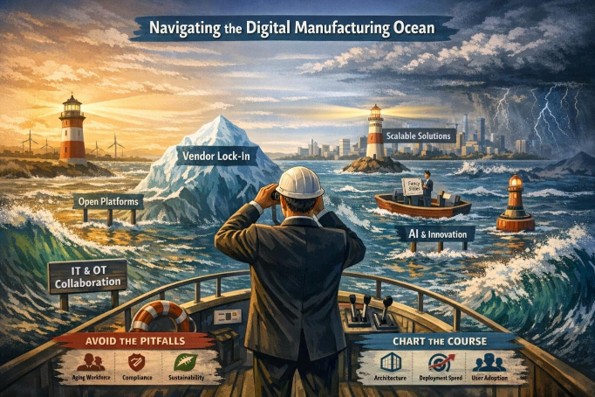
Vendor lock-in is becoming a real concern. The era of rigid, closed platforms is coming to an end — and vendors know it. Platforms built around concepts like the Unified Namespace (UNS), which decouple data from applications, are key to building resilient, scalable architectures.
When talking about platforms (OT Data platforms, MES/MOM platforms), differentiate those that chose to be open from those who are not. Is there info available on open sources (e.g. youtube, their website, library?)
Product demos matter — they often create end-user buy-in. A platform with a great UI and many features can look very appealing. But try to go beyond the interface. Some of the most promising platforms are headless, meaning you can connect the UI of your choice — open or commercial — without architectural compromise.
AI will be everywhere. Expect impressive demos. The real question is not if AI exists, but whether it accelerates time to value in a meaningful way.
When making plans for digitalization:
Make sure your IT and OT teams collaborate. Too much politics may hamper the transformation, create unnecessary tensions, risks. In the end, a ton of effort for little value.
Consultants (hey, I am one of them) and their fancy slides. I have seen a great deal of consultative fancy slides describing the best processes and approaches for governing a Digital program, they look so nice until you see how it transforms into reality. They often fail when they define a Digital manufacturing program like if it was an SAP.
It’s equally important to the process to define a good cultural approach, take into account, in Plants you have engineers/operators/supervisors that speak and own crucial tribal knowledge. If you don’t dedicate enough to user adoption, this will fail. Guarantee.
Ensure true collaboration between IT and OT teams. Politics and siloed ownership create risk, slow down transformation, and often result in a lot of effort for little value.
Consultants (yes, I am one of them) and fancy slides. I’ve seen countless polished frameworks describing how to govern digital manufacturing programs. They look great — until reality hits. Many approaches fail because digital manufacturing is treated like an SAP rollout. It isn’t.
Process alone is not enough. Culture matters just as much. In plants, engineers, operators, and supervisors hold deep tribal knowledge. If user adoption is not treated as a first-class concern, the initiative will fail — guaranteed.
Scalability: two angles that really matter
When we talk about scalability, I always look at it from two different perspectives:
Can I scale my solutions and platforms? Do I have the right infrastructure in place? This is where you need to involve your architects early and define a clear target architecture. Without this, scaling beyond pilots becomes slow, expensive, and fragile.
Can I accelerate deployment? Scalability is not only about technology, but also about execution speed. Challenge your consultants and solution providers:
Are they able to develop and deploy faster?
Are they using modern engineering practices?
Are they leveraging AI-enabled DevOps to reduce lead time and cost?
Both dimensions are essential. One without the other will limit your ability to scale digital manufacturing initiatives effectively.